Ichthyosis (ICH) & Ichthyosis 2 (ICH2)
There are now two mutations of Ichthyosis in Golden Retrievers, and require separate testing for each. Ichthyosis (ICH) and Ichthyosis 2 (ICH2) are an autosomal recessive genetic mutation that affects the skin of Golden Retrievers. The mutation prevents the outer layer of the epidermis from forming properly, resulting in skin that becomes darkened and thick, with excessive flaking.
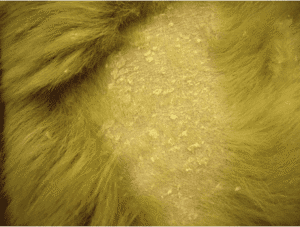
The name “Ichthyosis” is derived from the Greek word for fish. This describes the skin’s resemblance to fish scales. The most common symptom of ICH/ICH2 is excessive flaking of the skin. Other symptoms include areas of hardened skin and hyperpigmentation, which may make the skin appear dirty or blackened. Symptoms can be mild or severe. Evidence of the disease may be detected when the dog is still a puppy, but symptoms may take a year or more to develop. Additionally, symptoms can improve or worsen, depending on stress and hormonal cycles. ICH2 is characterized by severe flaking with large amounts of whitish to brown scales and secondary infections with Malassezia. Weight loss and lethargy are associated with ICH2. These are often not manageable with medications or baths.
ICH/ICH2 is generally not dangerous to a dog’s health but can be unsightly and uncomfortable for the dog. ICH/ICH2 is frequently related to other health issues such as yeast overgrowth and fungal infections. A dog diagnosed with ICH/ICH2 will usually require more care with special shampoos and treatments. ICH/ICH2 is unfortunately quite common in Golden Retrievers but can be identified with a simple DNA test. A dog with ICH/ICH2 would need to inherit the mutation from both parents, as the mutation is autosomal recessive.
Progressive Rod-Cone Degeneration (PRCD) and Progressive Retinal Atrophy (PRA)
Progressive Rod-Cone Degeneration (PRCD) is a form of Progressive Retinal Atrophy (PRA) in which the cells in the dog’s retina degenerate and die. PRCD-PRA for dogs is similar to retinitis pigmentosa in humans. Most affected dogs will not show signs of vision loss until 3-5 years of age. Complete blindness can occur in older dogs.
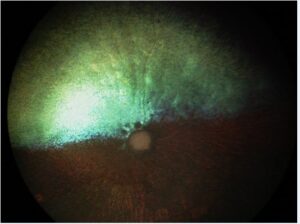
The retina is a membrane located in the back of the eye that contains two types of photoreceptor cells. These cells take light coming into the eyes and relay it back to the brain as electrical impulses. These impulses are interpreted by the brain to create images. In dogs suffering from PRCD or PRA, the photoreceptors begin to degenerate, causing an inability to interpret changes in light. This results in a loss of vision. Rod cells, which normally function in low-light or nighttime conditions, begin to degenerate first. This leads to night-blindness. The cone cells, which normally function in bright-light or daytime conditions, will deteriorate next. Over time this can lead to complete blindness.
Progressive Retinal Atrophy 1 (PRA1) & Progressive Retinal-A
In addition to the PRCD-PRA mentioned above, two mutations have been identified specifically in Golden Retrievers. They are known as PRA1 and PRA2. Progressive Retinal Atrophy (PRA) is a category of genetic mutations that cause vision loss and blindness. Photoreceptor cells in the retina begin to degenerate, typically progressing from a loss of night vision to complete blindness. PRA affects many different dog breeds, and these two mutations are breed-specific.
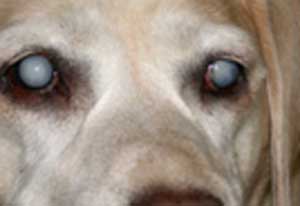
Both PRA1 and PRA2 are inherited in an autosomal recessive manner. This means that a dog must inherit a copy of the mutation from each parent to be affected by the disorder. Dogs with one copy of the mutation will not show any signs or symptoms of PRA, however, they can still pass on that mutation to any offspring.
Degenerative Myelopathy (DM)
Degenerative Myelopathy (DM) is a progressive neurological disorder that affects the spinal cord of dogs. Dogs that have inherited two defective copies will experience a breakdown of the cells responsible for sending and receiving signals from the brain, resulting in neurological symptoms.
The disease often begins with an unsteady gait, and the dog may wobble when they attempt to walk. As the disease progresses, the dog’s hind legs will weaken and eventually the dog will be unable to walk at all. DM moves up the body, so if the disease is allowed to progress, the dog will eventually be unable to hold his bladder and will lose normal function in its front legs. Fortunately, there is no direct pain associated with DM.
The onset of DM generally occurs later in life starting at an average age of about 10 years. However, some dogs may begin experiencing symptoms much earlier. A percentage of dogs that have inherited two copies of the mutation will not experience symptoms at all. Thus, this disease is not completely penetrant, meaning that while a dog with the mutation is likely to develop DM, the disease does not affect every dog that has the genotype.
Muscular Dystrophy (MD)
Muscular Dystrophy (MD) is a mutation of the dystrophin gene that causes a deficiency of dystrophin proteins in Golden Retrievers. The lack of dystrophin proteins leads to the progressive degeneration of skeletal and cardiac muscles. The disease is similar to the human disease, muscular dystrophy. Symptoms appear relatively quickly, at about six weeks to two months of age. A dog with muscular dystrophy will exhibit muscle weakness, difficulty standing or walking normally, and difficulty swallowing. Symptoms can range from relatively mild to severe, but MD is generally fatal at about 6 months of age.
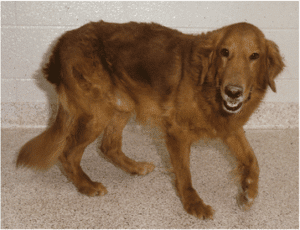
The MD mutation is sex-linked and located on the X chromosome. So, while both male and female dogs can be affected, MD is mostly a disease related to male Goldens. Females can be carriers of the mutation, however, will not exhibit any symptoms.
Neuronal Ceroid Lipofuscinosis (NCL)
Neuronal Ceroid Lipofuscinosis (NCL) is a very serious progressive degeneration disease of the central nervous system. In Golden Retrievers, NCL is caused by a 2 base pair deletion in the CLN5 gene causing a frameshift and premature termination codon.
Affected Golden Retrievers begin to develop signs of the disease around 13 months old. Often the first sign of NCL is a loss of coordination during basic movements including walking, running, climbing stairs, particularly when excited. As the disease progresses, the loss of coordination becomes evident even when the dogs are calm. Affected dogs may also experience tremors, seizures, or blindness. Compulsive behaviors, anxiety, and loss of previously learned behavior are also common. Affected dogs may likewise become agitated or aggressive as the disease continues to progress. Due to the severity of the disease and loss of quality of life, most affected dogs are euthanized by 2-3 years of age.
This one is serious. Unlike the other genetic deficiencies that are more quality of life issues, this one will kill your Golden Retriever. Period. No questions asked. DO NOT ADOPT A GOLDEN RETRIEVER THAT IS NOT TESTED FOR NCL!